

Cosmetic finished products
From the pre-assessment of a formulation to the Cosmetic Product Safety Report, through in vitro assays on reconstructed models and use tests on volunteers, Eurosafe covers the full regulatory and marketing needs of your finished cosmetic products.

Regulatory toxicology
Our team will ensure that your product is compliant with European regulations.
Article 3 of Cosmetic Regulation (EC) No 1223/2009 states: “A cosmetic product made available on the market shall be safe for human health when used under normal or reasonably foreseeable conditions of use.”
Pre-assessment safety report
The purpose of pre-assessment safety reports is to establish an initial review of the regulatory compliance and safety of formulations that are still in development or that have been designed for vulnerable target populations (i.e. babies, pregnant or breastfeeding women, etc.).
With these pre-assessment safety reports, Eurosafe guides you on the following matters:
- the decision to undergo specific in vitro or clinical tolerance tests to ensure product safety,
- a precise listing of all tests that may potentially be required, according to anticipated labeling and written usage guidelines,
- potential recommendations for usage precautions to label.
Cosmetic Product Safety Report (CPSR)
When the product is ready for sale, a safety report is established according to the requirements of Annex I of Cosmetics Regulation (EC) No 1223/2009.
This report, which corresponds to the main component of the Product Information File (PIF), includes two parts:
- Part A — Cosmetic product safety information
- Part B — Cosmetic product safety assessment
The safety assessment, or toxicological risk assessment, is performed on the basis of the cosmetic formulation and the normal or reasonably foreseeable conditions of use.
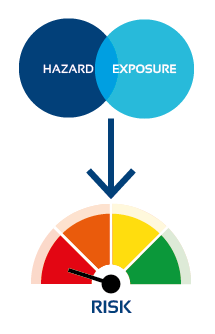
Eurosafe has a database with toxicological profiles of several thousand cosmetic substances, enabling the evaluation of diverse types of cosmetic products.
Product Information File
The product information file (PIF) includes all information relating to identity, quality, safety, and claims of cosmetic products. It consists of five parts:
- 1st part: administrative data (product description, responsible parties, contact persons, etc.),
- 2nd part: cosmetic product safety report,
- 3rd part: manufacturing and packaging methods (in conformity with Good Manufacturing Practices ISO 22716),
- 4th part: claims and effectiveness,
- 5th part: data on animal experimentation.
In addition to creating the PIF, Eurosafe offers the following services:
- product notifications on the EU Cosmetic Notification Portal,
- regulation analysis and compliance of your labelling.
Customized evaluation methods
To meet the specific safety challenges and expectations of a market where innovation is central, Eurosafe is able to develop customized evaluation methods specifically adapted to your needs.
In vitro assays
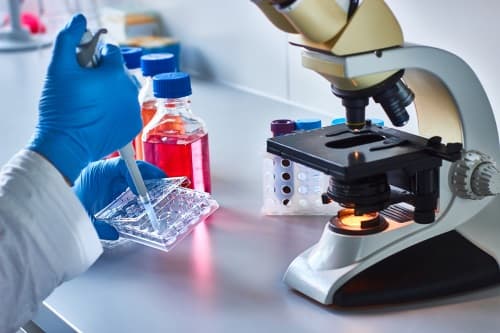
Our laboratory historically specializes in in vitro studies. We offer a portfolio of assays ranging from the well-established to the most cutting-edge. Some assays are regulatory compliant to ensure safety and tolerance of finished cosmetic products.
Transcutaneous passage
Evaluation of the dermal absorption and delivery of a test substance using excised skin.
In order to evaluate the possibility of peripheral effects during dermal administration of test compounds, it is essential to evaluate these compounds' potential transcutaneous passage.
In vitro methods measure the diffusion of chemicals across skin into a fluid reservoir. Cryopreserved skin is used to measure diffusion only, whereas fresh metabolically-active skin is used to simultaneously measure diffusion and skin metabolism.
Such methods have found particular usage as screening tests for comparing transcutaneous delivery of chemicals from different formulations. These methods also provide useful models for the assessment of percutaneous absorption in humans. Acceptable data from a minimum of four replicates per test preparation are required.
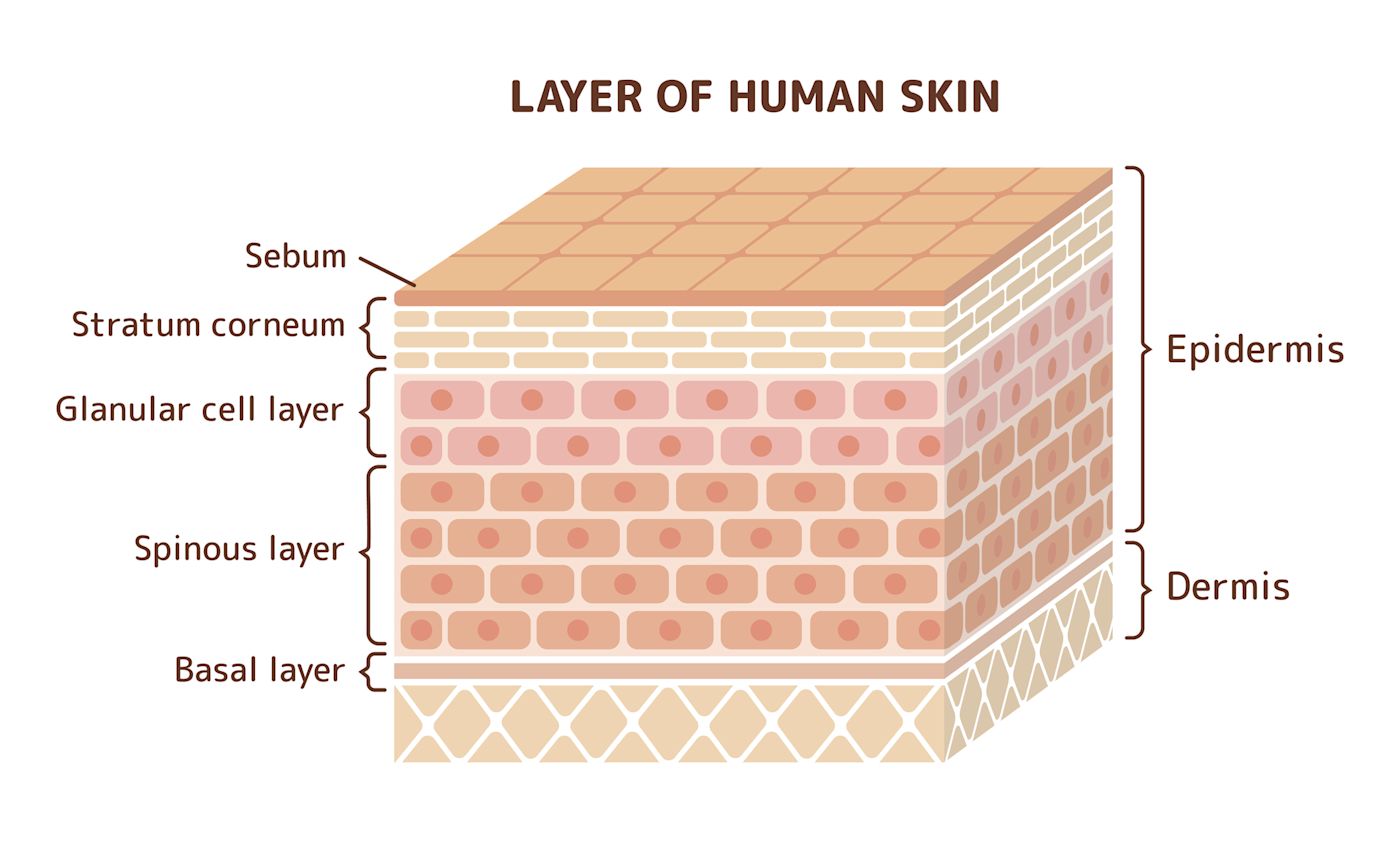
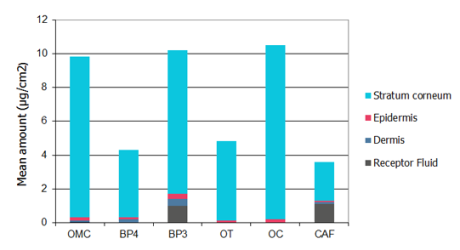
Using appropriate conditions, which are described in the OECD 428 guidelines, absorption of test compounds during a given time interval is measured by analyzing both receptor fluid and the treated skin.
The test compound remaining on the skin's surface should be considered as absorbed unless it can be conclusively demonstrated that absorption can be determined from receptor fluid values alone.
Analysis of other components (e.g. material washed off the skin or remaining within skin layers) allows for further data evaluation, including total test substance disposition and percentage recovery.
All components of the skin should be analyzed, and recovery should also be determined. This includes rinsing of the donor chamber, skin surface, and the receptor fluid/chamber. In some cases, the skin may be fractionated into stratum corneum, epidermis, and dermis fractions for additional analysis.
Effect of the formulation on the transcutaneous absorption of a test compound
Challenge test
Test of the efficacy of antimicrobial preservation in cosmetic products.
Two methods are used:
- one according to the European Pharmacopoeia,
- and another according to ISO 11930.
This test is performed by our specialist partner in microbiology.
Ocular irritation — HET-CAM
Evaluation of potential irritation after application to the chorioallantoic membrane of embryonic hens' eggs.
Published in the Official Journal of the French Republic on December 26, 1996.
Ocular irritation — Neutral red release
Evaluation of potential irritation by direct application to rabbit cornea fibroblasts using the neutral red release method.
Published in the Official Journal of the French Republic on December 30, 1999.
Ocular irritation — Reconstructed model (3D)
Evaluation of ocular tolerance performed on 0.5 cm² reconstructed corneal epithelium (HCE) obtained from human corneal epithelial cells.
The assay was developed based on guidelines related to ingredients and further adapted to finished products, in collaboration with Pierre Fabre. It is based on scientific data measuring the correlation between classifications obtained during clinical tests and in vitro tests.
Advantages:
- the model displays greater resemblance to real human tissue, increasing its relevance and predictive power as related to normal physiology;
- it enables execution of more relevant and reliable tests, closer to usual conditions of product application.
Cutaneous irritation — Prediskin
Method exclusively developed and used by Eurosafe for the evaluation of potential skin irritation, performed on fresh human skin discs.
Product effects on the epidermis are evaluated using an MTT cell viability test.
Cutaneous irritation — Reconstructed model (3D)
Evaluation of cutaneous tolerance performed on reconstructed human epidermis (RHE) of 0.5 cm² obtained from normal human keratinocytes.
The assay was developed based on guidelines related to ingredients and further adapted to finished products, in collaboration with Pierre Fabre. It is based on scientific data measuring the correlation between classifications obtained during clinical tests and in vitro tests.
Advantages:
- the model displays greater resemblance to real human tissue, increasing its relevance and predictive power as related to normal physiology;
- it enables execution of more relevant and reliable tests, closer to usual conditions of product application.
Vaginal irritation — Reconstructed model (3D)
Evaluation of tolerance performed on reconstructed vaginal epithelium (HVE) derived from squamous cell carcinoma of the vulva.
The assay was developed based on guidelines related to ingredients and further adapted to finished products, in collaboration with Pierre Fabre. It is based on scientific data measuring the correlation between classifications obtained during clinical tests and in vitro tests.
Advantages:
- the model displays greater resemblance to real human tissue, increasing its relevance and predictive power as related to normal physiology;
- it enables execution of more relevant and reliable tests, closer to usual conditions of product application;
- it provides a solution for the evaluation of intimate hygiene products.
Gingival irritation — Reconstructed model (3D)
Evaluation of gingival tolerance performed on reconstructed gingival epithelium (HGE) of 0.5 cm² derived from transformed human gingival epithelial cells.
The assay was developed based on guidelines related to ingredients and further adapted to finished products, in collaboration with Pierre Fabre. It is based on scientific data measuring the correlation between classifications obtained during clinical tests and in vitro tests.
Advantages:
- the model displays greater resemblance to real human tissue, increasing its relevance and predictive power as related to normal physiology;
- it enables execution of more relevant and reliable tests, closer to usual conditions of product application;
- it provides a solution for the evaluation of oral hygiene products.
Phototoxic potential — Reconstructed model (3D)
Evaluation of potential cutaneous phototoxicity on reconstructed human epidermis (RHE) upon UVA exposure. The effects of the product on the epidermis are evaluated by an MTT cell viability test.
The assay was developed based on guidelines related to ingredients and further adapted to finished products, in collaboration with Pierre Fabre. It is based on scientific data measuring the correlation between classifications obtained during clinical tests and in vitro tests.
Advantages:
- the model displays greater resemblance to real human tissue, increasing its relevance and predictive power as related to normal physiology;
- it enables execution of more relevant and reliable tests, closer to usual conditions of product application;
- it allows products to meet the requirements of vegan claims.
In vivo assays
Eurosafe evaluates tolerance and efficacy using standardized assays or personalized protocols compliant with your claims. Our team is available to discuss and support you in all your development projects.
Patch test
Cutaneous tolerance evaluated by patch test under dermatological control.
- 20 volunteers,
- 1 reading at 48 h.
Use test
We support different players in the cosmetics industry across all distribution channels.
Our goal is to offer you:
- competitive prices,
- flexibility and optimized delivery times,
- personalized follow-up.
Our teams are at your disposal to discuss your projects in detail and to offer standardized or specific assays according to your specifications.
Our services:
- standardized assays to evaluate tolerance and perceived efficacy of your products
- collaboration with medical specialists according to your needs (dermatologists, ophthalmologists, gynecologists, oral-maxillofacial surgeons, etc.);
- subjective evaluation of efficacy using post-study surveys that measure the percentage of satisfaction.
- innovative tests to evaluate the efficacy of your products
- skin microbiome evaluation: determination by 16S metagenomic sequencing of the bacterial composition of cutaneous samples taken from volunteers during a use test, to conclude that the tested product does not imply a major modification of the microbiota.
- a database of volunteers with general or specific populations
- sensitive skin, mature skin, dry skin, damaged hair, lens wearers, sensitive mucous membranes…
- Caucasian and Asian subjects, with tests conducted in Asia.
These solutions apply to all your finished cosmetic products: rinsed and leave-on hygiene products, intimate hygiene products, care products, anti-wrinkle products, slimming products, deodorants, oral products, makeup, hair colouring…
And answer all your claims: moisturizing, anti-wrinkle, firming, sebum-regulating, deodorant effect, slimming, anti-dark-spot, non-comedogenic…
Objective efficacy measures
Regulations require that any claimed effect must be supported by appropriate evidence, and prohibit the false attribution of unverified features or functions to any product. The efficacy of cosmetic products must be established from data collected on the ingredients and on the finished product.
Claims relating to cosmetic products, whether explicit or implicit, must be based on adequate and verifiable evidence, irrespective of their type…
Extract from Commission Regulation (EU) No 655/2013 of 10 July 2013, which established the common criteria related to cosmetic claims.
Our services:
- well-established methods to objectively measure your claims:
- instrumental measurements: cutometry, corneometry, chromametry, glossymetry, sebumetry, impedance, centimetric measurements…
- self-evaluation: evaluation conducted by volunteers using a visual analogue scale at inception and completion of the study; percentage change is assessed for each evaluated parameter;
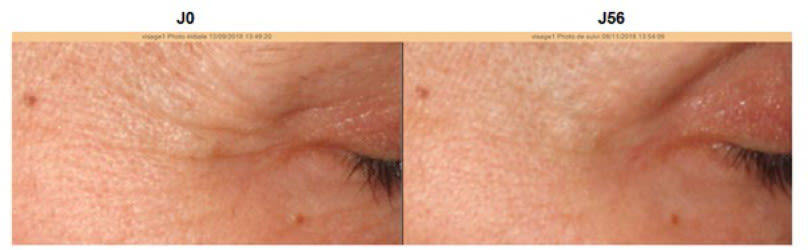
- expert evaluation: wrinkle scoring on a photographic scale (Fotofinder Mediscope), sniff test, quantification of comedones…
- specific methods:
- 16S metagenomic sequencing for skin microbiome evaluation: determination of the bacterial composition of cutaneous samples taken from volunteers during a use test, to conclude that the tested product does not imply a major modification of the microbiota.
Tailor-made assays
To meet your specifications, Eurosafe offers jointly-developed and customizable protocols for your cosmetic products.
Examples of personalized studies:
- consumption and exposure study — sunscreen products,
- consumption and exposure study — oral products.