

Cosmetic and chemical ingredients
Your customers are looking for innovative and effective ingredients. Eurosafe documents their toxicological profile, validates their maximum use concentration, and gives you access to the reference NAMs for skin sensitization.

Regulatory toxicology
Our customers are looking for innovative and effective ingredients for efficient formulations.
Eurosafe can offer you different solutions to meet regulatory requirements.
Toxicological profile of cosmetic ingredients
Thanks to an exhaustive review of regulatory and safety data available in the literature, Eurosafe assists you in writing the toxicological profiles of all types of ingredients for cosmetic use.
The purpose of the toxicological profile is to identify all the hazards inherent to a substance and to characterize the dose-response relationship on the basis of the different toxicological endpoints targeted by the SCCS.
If the toxicological data collected remain insufficient, additional in vitro test recommendations according to the established ECVAM/OECD protocols may be established.
The development of these profiles allows you to guide the use of your cosmetic ingredients in finished products, especially for specific targets such as pregnant or breastfeeding women and babies.
Safety assessment of cosmetic ingredients
The safety evaluation of a cosmetic ingredient enables you to determine or validate the maximum concentration of use of an ingredient for one or several categories of cosmetic products and for one or several target populations.
The aim is to ensure the safe use of the ingredient under normal and reasonably foreseeable conditions of use.
Complementary to the toxicological profile, this service aims to better guide you in choosing and using cosmetic ingredients when developing new cosmetic products.

In vitro assays
Our laboratory historically specializes in in vitro studies. We offer a portfolio of assays ranging from the well-established to the most cutting-edge, some of which are regulatory compliant, to ensure the safety and tolerance of cosmetic and chemical ingredients.
The assessment of skin sensitization is now based on NAMs (New Approach Methodologies) recognized by regulatory authorities. Eurosafe offers a dedicated portfolio combining reference NAMs, innovative approaches and regulatory expertise.
Transcutaneous passage
Evaluation of the dermal absorption and delivery of a test substance using excised skin.
In order to evaluate the possibility of peripheral effects during dermal administration of test compounds, it is essential to evaluate their potential transcutaneous passage.
In vitro methods measure the diffusion of chemicals across skin into a fluid reservoir. Cryopreserved skin is used to measure diffusion only, whereas fresh metabolically-active skin is used to simultaneously measure diffusion and skin metabolism.
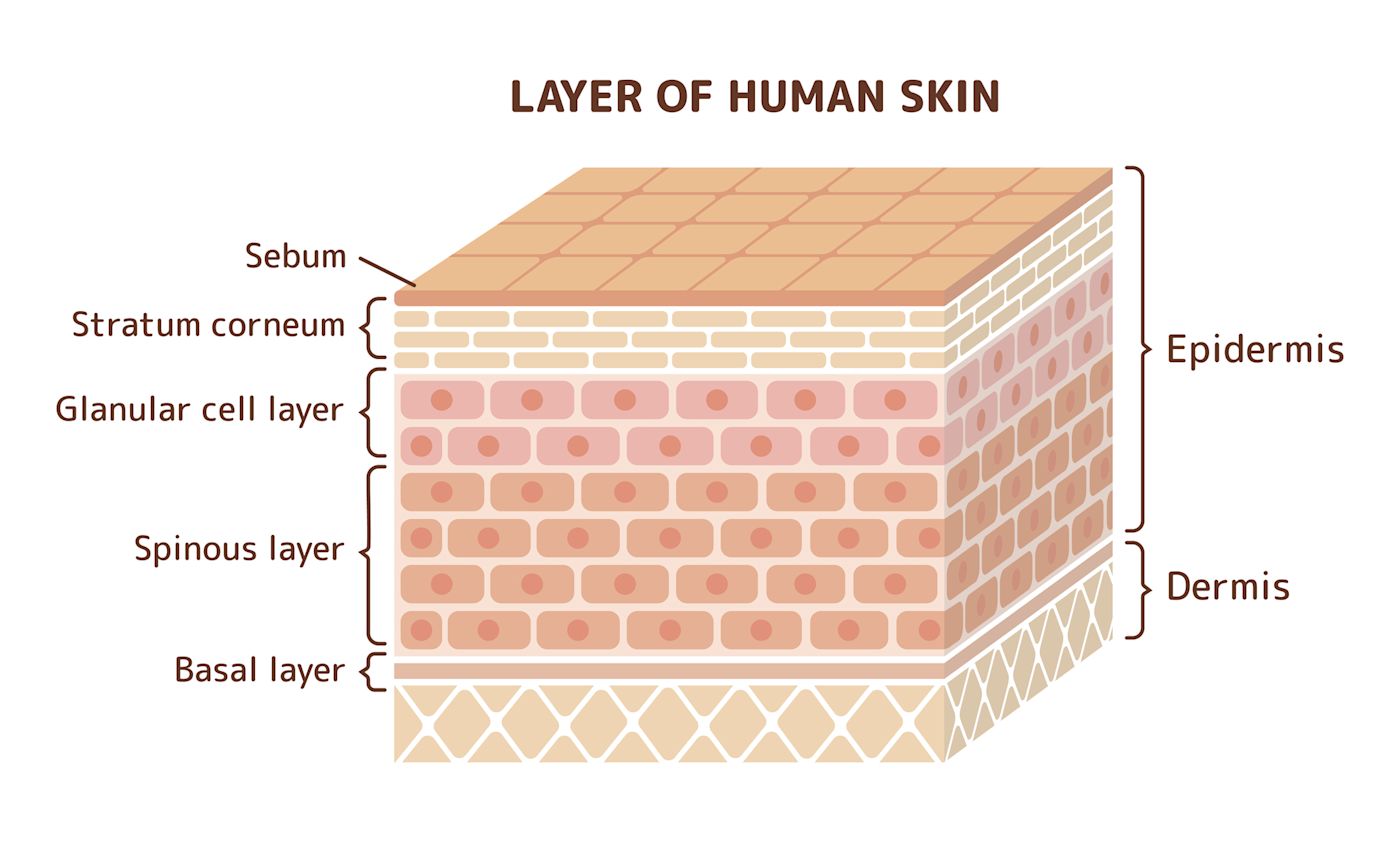
Using the conditions described in the OECD 428 guidelines, absorption of test compounds during a given time interval is measured by analyzing both receptor fluid and the treated skin. Acceptable data from a minimum of four replicates per test preparation are required.
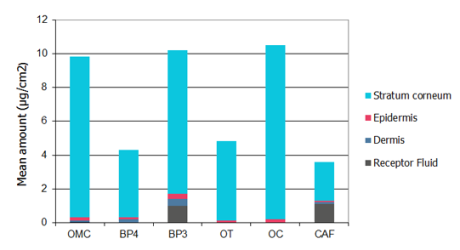
Effect of the formulation on the transcutaneous absorption of a test compound
Skin sensitization — h-CLAT® (Human Cell Line Activation Test)
The h-CLAT® is an in vitro method recognized as a NAM for assessing the skin sensitization potential of chemicals and cosmetic ingredients. Performed using the human THP-1 cell line, this test measures the expression of the CD86 and CD54 markers associated with dendritic cell activation.
Compliant with OECD Test Guideline 442E, the h-CLAT® addresses Key Event 3 of the Adverse Outcome Pathway (AOP) for skin sensitization and is one of the reference methods integrated into Defined Approaches (OECD 497).
At Eurosafe, the h-CLAT® has been conducted under GLP for more than 10 years, combining scientific expertise, regulatory know-how and the generation of robust data to support your safety assessments.
Skin sensitization — KeratinoSens™
The KeratinoSens™ assay is a validated in vitro method recognized by the OECD (Test Guideline 442D) for assessing the skin sensitization potential of chemicals and cosmetic ingredients.
This method addresses Key Event 2 (KE2) of the AOP for skin sensitization, namely the activation of keratinocytes through the Nrf2/ARE signaling pathway.
The assay is based on a genetically modified human keratinocyte cell line containing a reporter gene under the control of an Antioxidant Response Element (ARE). Activation of this pathway is measured by quantifying luciferase activity, identifying substances likely to induce a sensitizing response.
KeratinoSens™ is part of the Defined Approaches described in OECD TG 497 and is a key element of modern NAM-based assessment strategies.
Skin sensitization — DPRA (Direct Peptide Reactivity Assay)
The DPRA is a validated in chemico method recognized by the OECD (Test Guideline 442C) for assessing the skin sensitization potential of chemicals and ingredients.
This method addresses Key Event 1 (KE1) of the AOP for skin sensitization, namely the covalent binding of an electrophilic substance to skin proteins. This molecular interaction represents the initiating event of the skin sensitization process.
The DPRA is integrated into the Defined Approaches described in OECD Test Guideline 497 and is considered a reference method for characterizing the molecular initiating event within the NAM framework.
Skin sensitization — SENS-IS
The SENS-IS assay, developed by Immunosearch, quantitatively measures the over-expression of 62 specific biomarkers of skin sensitization, irritation and the Redox system by RT-PCR, after application of chemicals, mixtures or natural extracts on 3D reconstructed human epidermis.
- qualitative and quantitative response;
- distinguishes irritation from sensitization;
- 3D reconstructed epidermis: closer to real skin, therefore a complete biological system accounting for multiple cellular responses;
- larger domain of application than other sensitization assays, with the capacity to test lipophilic compounds;
- good concordance with the LLNA;
- suitable for finished products;
- covers Key Event 2 (activation of keratinocytes).
OECD validation is in progress.

In silico studies / Computational toxicology
Our in silico services expedite the prediction of biological properties, predictive toxicology and ADME prediction through physiologically based pharmacokinetic (PBPK) modelling, on state-of-the-art computing facilities.
Structure modeling
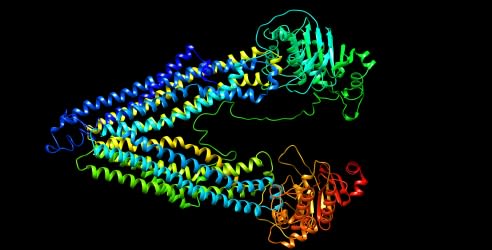
Eurosafe offers services for the prediction of the three-dimensional structure of proteins by homology modeling, using automated state-of-the-art methods. This approach uses the sequence similarity of amino acid residues with well-known 3D structures (X-ray or NMR) to predict the structure of an unknown protein.
The service includes:
- sequence alignment of amino acids,
- prediction of the 3D model,
- structure validation,
- structure optimization by molecular dynamics.
Molecular docking
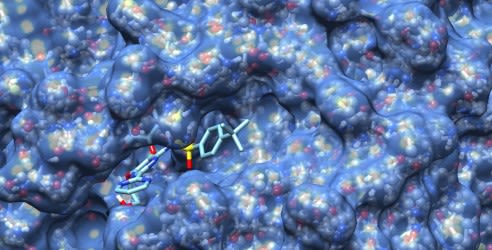
Eurosafe offers a molecular docking service to determine the interaction between the protein of interest and a ligand by an automated high-throughput screening algorithm. We report binding affinity, ligand conformation and active site prediction.
The service includes:
- structure preparation of protein and ligand,
- automated docking simulation,
- affinity prediction, ligand pose prediction and active site prediction,
- protein-ligand complex optimization by molecular dynamics.
QSAR
The Eurosafe QSAR service includes the prediction of relationships between the geometric structure of a chemical compound and its biological activity. We use methods such as the OECD Toolbox, VEGA and Toxtree to predict skin sensitization potential, according to OECD guidelines (ENV/JM/MONO(2007)2).
QSAR service includes:
- biological properties prediction,
- skin sensitization prediction of ingredients,
- skin metabolism and sensitization prediction,
- safety assessment of compounds.
PBPK
Eurosafe offers a physiologically based pharmacokinetic (PBPK) modeling service to predict the pharmacokinetics of compounds, using the validated open-source software PK-Sim.
- effect of dose and exposure duration (continuous or discontinuous, single or multiple exposures),
- effect of routes of administration (inhalation, ingestion…),
- species and individual variation,
- in vitro to in vivo extrapolation (IVIVE),
- study of drug-drug interactions (DDI),
- predictive ADME compartmental model.
Machine learning
Eurosafe offers a service to generate a customized prediction model of interest using machine learning algorithms. Machine learning is a branch of artificial intelligence that uses sophisticated algorithms to learn from data and make predictions.
We offer an in-house prediction model for the Bile Salt Export Pump (BSEP) protein in order to predict the ligandability of compounds with good accuracy, by combining in vitro data with in silico and physicochemical properties.
The service includes:
- a customized prediction model,
- ligandability of compounds for BSEP.